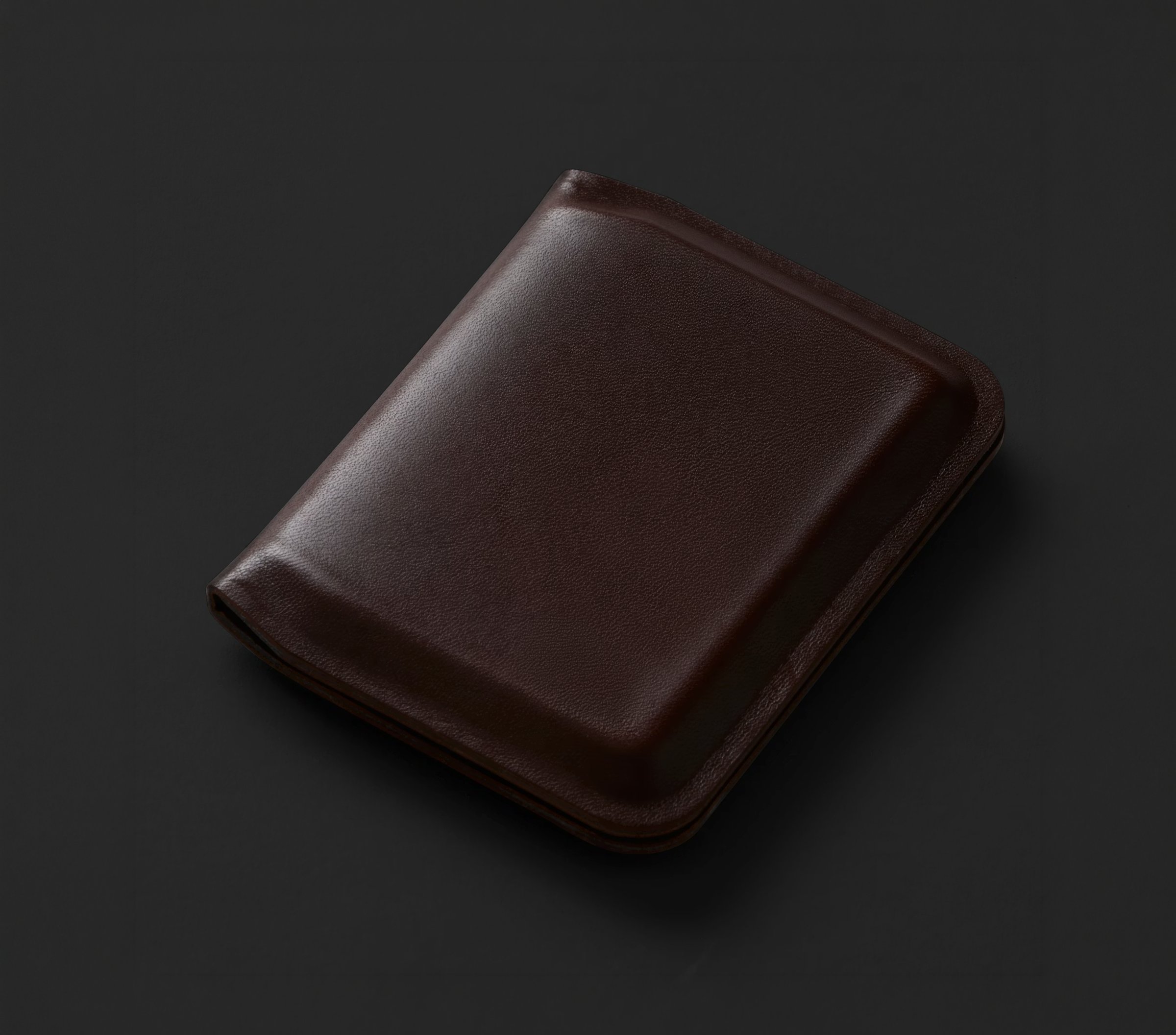
Men’s Accessories · Wallet Category · 2027
The Wallet Isn’t Disappearing.
It’s Getting Smaller.
Every 2027 decision rests on one question: what will a man still need to carry? Less than he carries today — but more than his phone can hold. Here is where the category is actually going, and what to do about it.
— flat two years running
are made with a phone
replaces the plastic card
— an all-time record
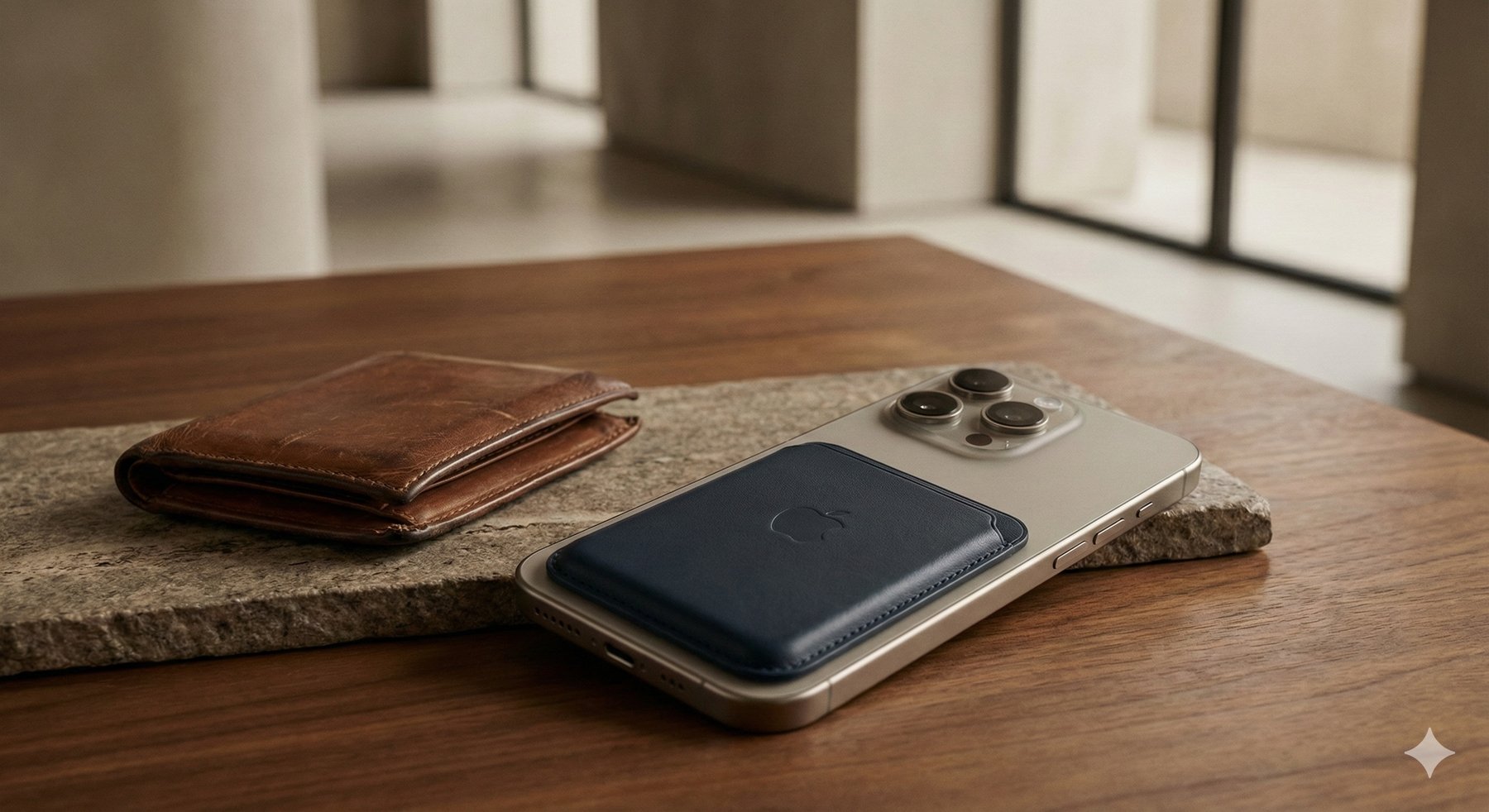
The Shift
The wallet is not emptying. It is thinning.
The story everyone tells is that the phone killed the wallet. The Federal Reserve’s numbers do not support it. Cash has held at 14% of payments for two consecutive years, 76% of Americans still carried cash on them in 2025, and five of every six cash payments are under $25. Cash stopped falling.
Tap-to-pay is now roughly 70% of face-to-face Visa transactions — but the overwhelming majority of those taps are a plastic card, not a phone. Phones are still only 14% of in-person payments. What changed is where the card gets tapped, not whether it exists.
Ask people directly and the picture is the same. Only 18% of mobile wallet users expect to stop carrying a physical wallet within five years; 64% expect they still will. Among Gen Z it is 25% — higher, but still a minority.
The wallet is not competing with the phone. It is competing with thickness. The man who wants five card slots instead of twelve is still a wallet customer — if the product is built for what he now wants.
The Real Clock
The threat isn’t Apple Pay. It’s the driver’s license.
A wallet exists as long as it holds something a phone cannot. Payment has largely moved. ID is the last thing holding the object together — so the only question that matters for long-range planning is how fast ID is moving. The answer is: far slower than the headlines.
Watch two triggers, not the state count. First, the first state to make a mobile ID legally sufficient at a traffic stop without the plastic card — Georgia’s law enforcement reader mandate lands July 2027, inside the planning horizon. Second, biometric e-gates at airports moving beyond today’s PreCheck pilots. Either one is a genuine step change. Another state adding Apple Wallet support is not.
Even the most bullish forecast — ABI Research, 143 million Americans holding a mobile ID by 2030 — describes people holding both. Their own framing: a companion to the classic licence, never the sole star. The wallet has this decade. What it does not have is twelve card slots.
Category Architecture
Five wallet categories. Each one serves a distinct carry need.
If the wallet is thinning rather than disappearing, the assortment question is which thickness each customer wants. These five categories are the foundation of everything downstream — product design, brand lanes, packaging and display.
The Carry Ladder
How much each wallet holds. Four categories arranged from full carry to phone-first — every product decision starts here.
Extra Capacity
6+ cards · dedicated bill compartment
10cards
New Classic
6–9 cards · slimmed bifold profile
8cards
Front Pocket
4–6 cards · cash via clip or pocket
5cards
Phone Companion
2–4 cards · cash optional · MagSafe
3cards
Gift & Special
Crosses all four lanes
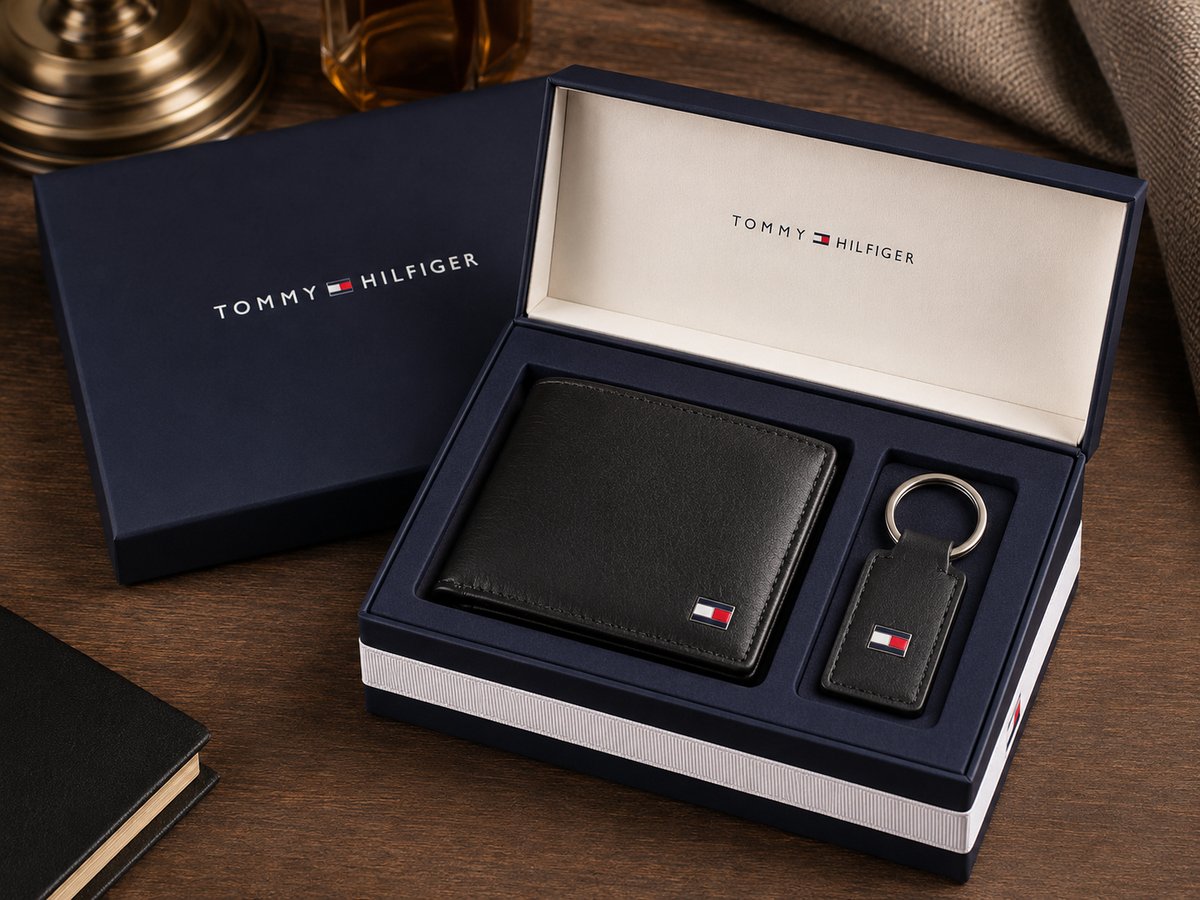
A presentation layer — not a carry type. Any wallet above becomes a Gift & Special SKU when paired with a card case, key fob, or coordinating wallet in premium packaging. Clothing and accessories is the No. 1 gift category at both seasonal peaks; this is where Q4 and Father’s Day live.
 Category 01
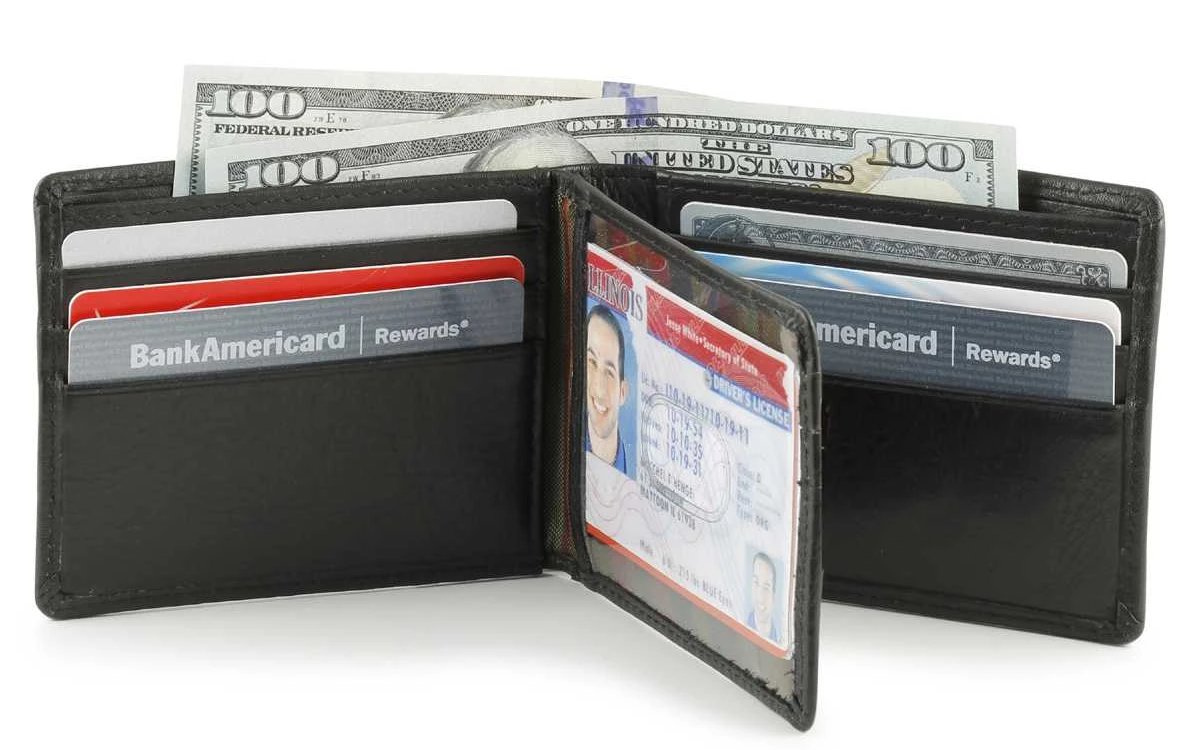
Extra Capacity
The full-carry customer
Bifolds and trifolds built to hold more. Slimfolds, passcases, and travelers that carry 6+ cards, have a dedicated bill compartment for cash, and may include zipper pockets or a bill divider. These haven't disappeared — they've just gotten smarter.
- 6+ card capacity, dedicated bill compartment
- Slimfold, passcase, traveler constructions
- Optional: zipper coin pocket, bill divider
 Category 02
New Classic
The updated traditionalist
Classic bifolds and trifolds — but slimmed down and upgraded. These hold 6–9 cards and some cash, with a bill compartment, but the focus is on slimmer profiles and modern features that reduce bulk without sacrificing the familiar format.
- 6–9 cards, bill compartment, slimmed profile
- Card ejector, magnet closure, or slip pockets
- Reduced thickness vs. legacy bifold construction
 Category 03
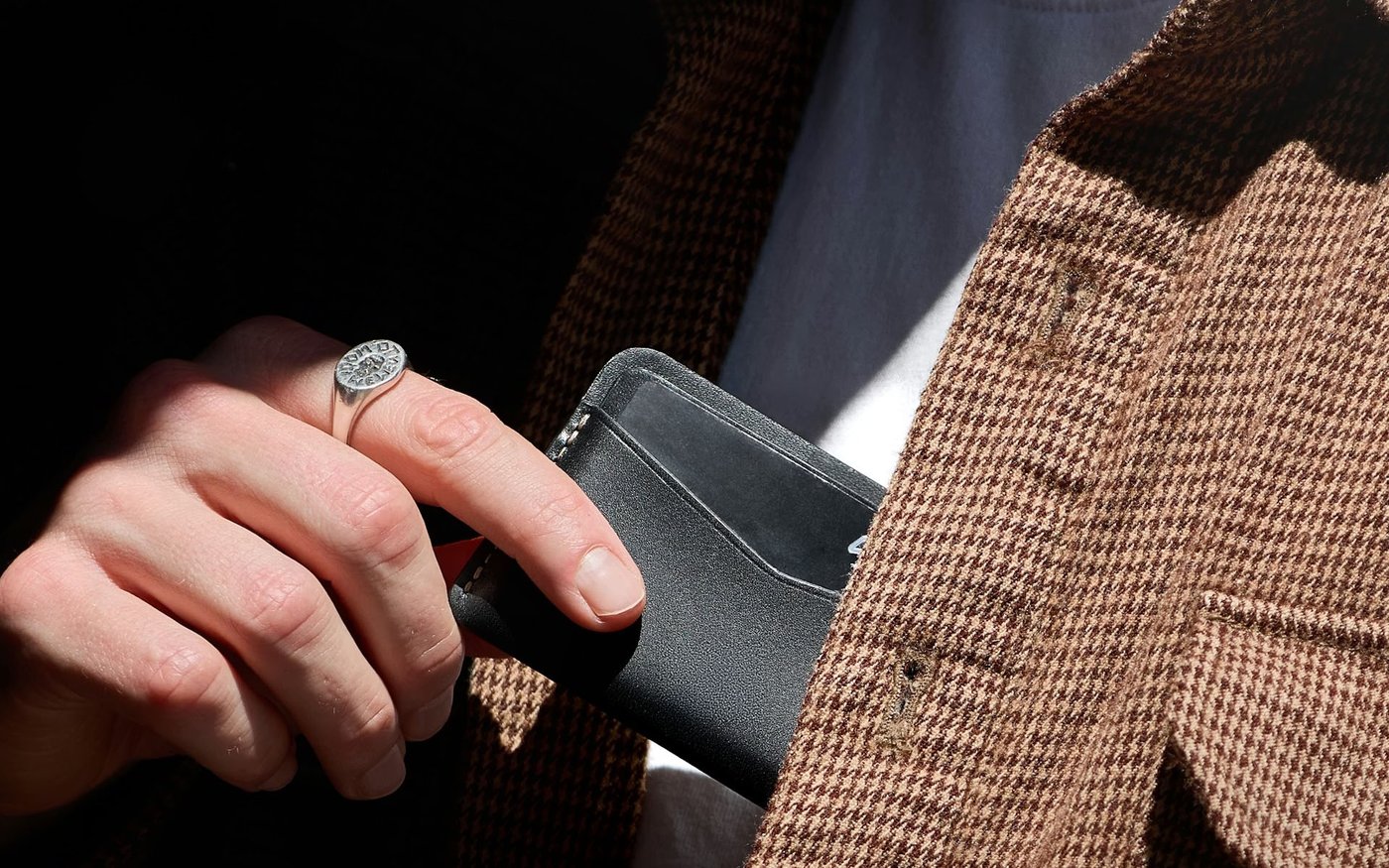
Front Pocket
The slim carry minimalist
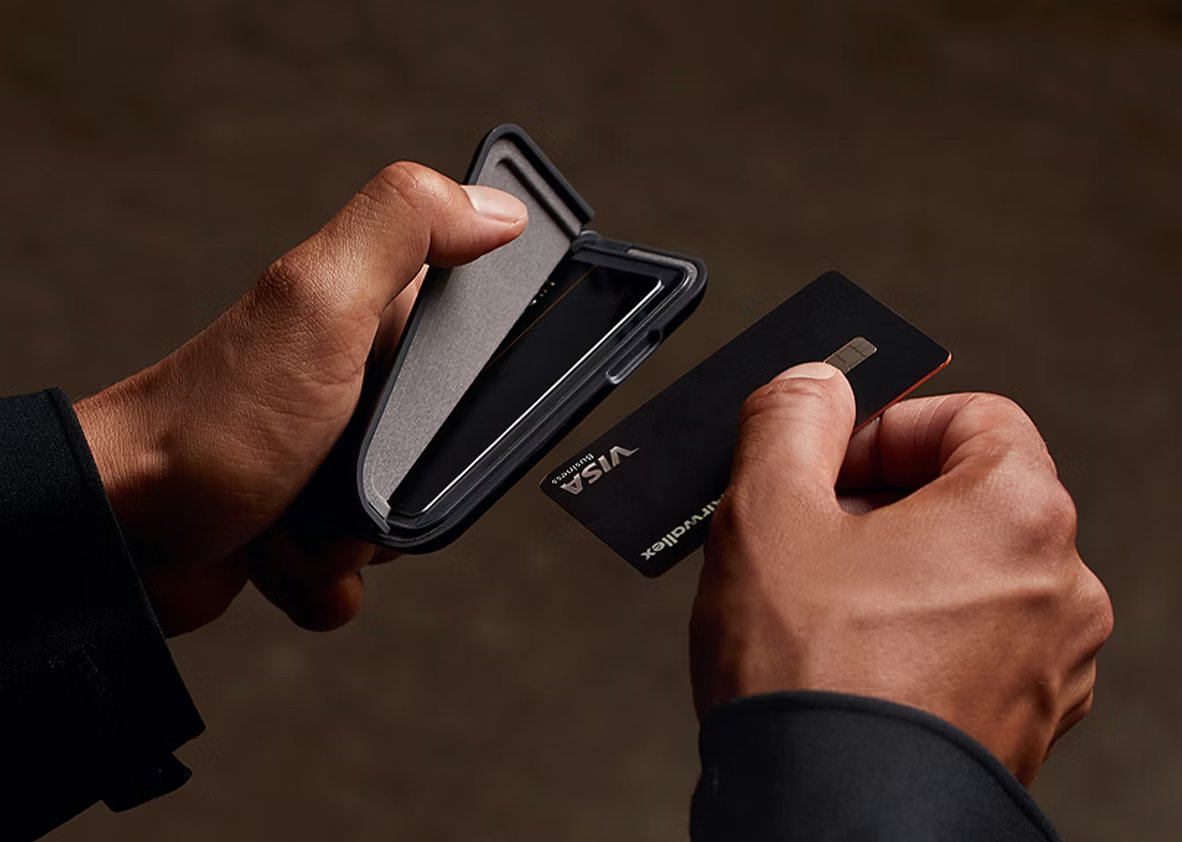
Smaller, slimmer, designed to live in a front pocket. Holds 4–6 cards and a few folded bills — in a pocket, or secured with a metal or magnetic money clip. Sometimes featuring zip closures. Built for the person who wants to carry less but still access cash.
- 4–6 cards, bills via pocket or money clip
- Metal or magnetic clip options; some zip closures
- Profile optimized for front-pocket carry
 Category 04
Phone Companion
The phone-first customer
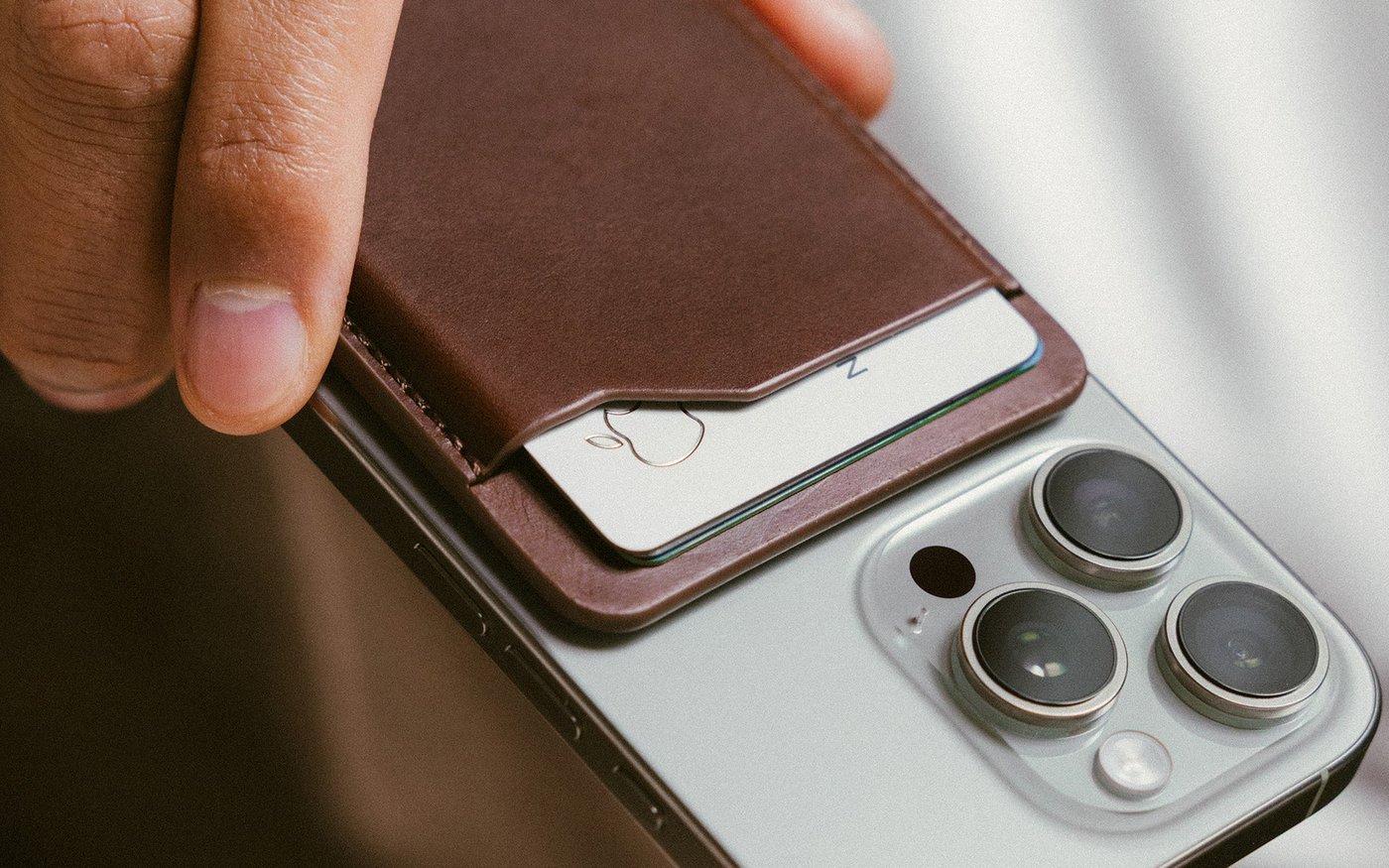
For the person who has primarily switched to Apple Pay or Google Pay. They need a few card slots as backup or for ID, and a cash pocket is a plus — not a requirement. Designed to attach to the phone via MagSafe. Can include a kickstand for added functionality.
- 2–4 card slots; cash optional
- MagSafe attachment (iPhone 12+)
- Optional kickstand feature
 Category 05
Gift & Special
The gift-giver
Wallets remain one of the most gifted men's accessories. This category adds value through presentation: a wallet paired with a card case, a key fob, or a money clip; or two coordinating wallets in premium packaging. The box is part of the product.
- Wallet + extra item (clip, case, key fob)
- Two-wallet coordinating gift sets
- Premium packaging — gift-ready out of the box
The Real Competitive Set
Four different fights, and only one of them is on the wallet fixture.
Prices below are live MSRP, checked September 2026 at the retailer or brand site. The four tiers do not meet each other — which is exactly the problem, because three of them are reaching the customer somewhere the licensed brands are not.
$46 – $185
The same wall
Other licensed brands
Fossil is the only true like-for-like — $46–55 core, same doors, a deeper named-family assortment. Its leather segment fell 38% in FY2025 to $69.3M, harder than its watches (−7%) or jewellery (−22%) — and it has now told investors it will “reinvigorate” the category. Also here: Michael Kors $79.50–129.50, Bosca $90–185, Johnston & Murphy $55–70, Original Penguin $48.
Fossil puts RFID in the product name, not on the hangtag. It reads from three feet away and survives into every search result.
$18 – $50
The retailer’s own label
Private label
Goodfellow $18–20 at Target. Sonoma $30 flat at Kohl’s — but in PU and split leather, so it is beating the licensed brands on spec, not on cost. Then the one that matters: Roundtree & Yorke $50 in soft nappa leather, a Dillard’s exclusive.
The $30 undercut is survivable — the material gap is arguable in front of a buyer. A $50 nappa exclusive sitting inside the licensed mid band, under Calvin Klein and Tommy Hilfiger at $54.50, is not.
$65 – $195
The slim specialists
DTC brands, now wholesale
Ridge $95–195, and no longer DTC in any meaningful sense — Nordstrom, Scheels, Buckle, Best Buy, 1,000+ doors. Bellroy runs nine SKUs at Nordstrom from $65 to $169. Ekster has one Nordstrom pop-up, not distribution. Secrid is Europe-led.
Bellroy’s $85–95 core lands exactly on the licensed premium band, at Nordstrom, with a lifetime warranty printed on the box.
$11 – $150
The phone aisle
MagSafe — the newest entry point
Apple FineWoven $59 sets the anchor. MOFT $30–60, Peak Design $49.95, Mous $49.99, Journey $70–130, Ridge MagSafe $75–150, Michael Kors $79.50. Opening price is $11–20; the volume zone is $30–60.
Every one of these is merchandised as a phone accessory, not a wallet. A $59 wallet next to a $39 charger reads normal. Next to a $30 bifold it reads absurd. The aisle sets the reference price.
The squeeze is from three sides at once. Private label takes the floor at $30 and matches the licensed brands at $50. The slim specialists take the ceiling at $95–195 with lifetime warranties. And the fastest-growing part of the category is in an aisle where leather-goods brands have almost no shelf presence. The licensed mid-band at $42–54.50 is the pressure point — and a MagSafe shipper is the one move that would put the portfolio where the growth is.
One spec note for any MagSafe shipper. Find My tracking has become table stakes above roughly $50 — Apple, MOFT, Journey, Nomad, Ekster and Secrid all carry it. A MagSafe wallet over $50 without tracking now looks under-specified. Peak Design is the exception that proves it: at $49.95 it drops both tracking and RFID and sells on capacity and a lifetime warranty instead.
How The Business Is Built
Three ways to sell. Only one of them is licensed.
The portfolio is wider than nine logos, and the two additions are the ones with room to grow.
01
Licensed
Nine brands, $42–95, the core of the business. Royalty and licensor approval sit on every decision, and the mid-band is where the squeeze is hardest.
02
Private label
On the same fixture, private label competes directly with the licensed brands. A buyer will ask what a logo adds at $48 against their own $50 nappa exclusive, and without a clear answer the linear foot is lost.
03
Non-branded
The newest and least defined. A MagSafe shipper would be the first real test — a small set of wallets, its own fixture, and packaging carrying materially more feature callouts than a standard wallet box. No licensor approval, no royalty, and it would land in the aisle where the category is actually growing.
What a MagSafe shipper would prove
That packaging would have to carry more information than any licensed wallet box — because in the phone aisle, that is the standard. MOFT sells on magnet strength in newtons and tracking range in metres. Apple leads with Find My and RFID. Nobody in the wallet aisle quantifies anything. The shipper should not be a one-off; it is the packaging standard the rest of the line should be held to.
The Gifting Business
This category has two peaks. Most lines plan for one.
A wallet is bought far more often as a gift than as a replacement. That makes the calendar, the price band and the box strategic decisions rather than operational ones — and it makes Father’s Day the most under-resourced opportunity on the calendar.
The season is barbelled — and the category ships to the middle of it
Early October
42% of holiday shoppers have already started, and a quarter of Deloitte’s respondents had spent their budget by 31 October. Kohl’s launched its gift shop on 9 October last year. A November floor set forfeits this quarter of the season.
Thanksgiving weekend
202.9 million shoppers, a record. 51% of them bought clothing or accessories — the top category of the weekend. This is the peak inventory position.
1 December
Only 51% of holiday shopping is done. Clothing and accessories is the single largest unfinished category at 48%. The fixture must still be full and shoppable.
20 December
Super Saturday: 158.9 million shoppers, the largest single day of the season. A fixture not replenished by mid-December misses it entirely.
June
Father’s Day. 77% celebrate; 45% buy for a father, but 48% buy for a husband, son, brother, grandfather or friend. This needs its own assortment and its own floor set — not Q4 carryover.

Packaging & Display Strategy
The product is better. Now it has to tell the story.
The five categories above represent real investment in product design. At retail and online the customer never sees that thinking — because the packaging says nothing and the display does nothing. In a category where most of the decision is made standing at the shelf, that is not a design problem. It is a revenue problem.
Current State — The Problem
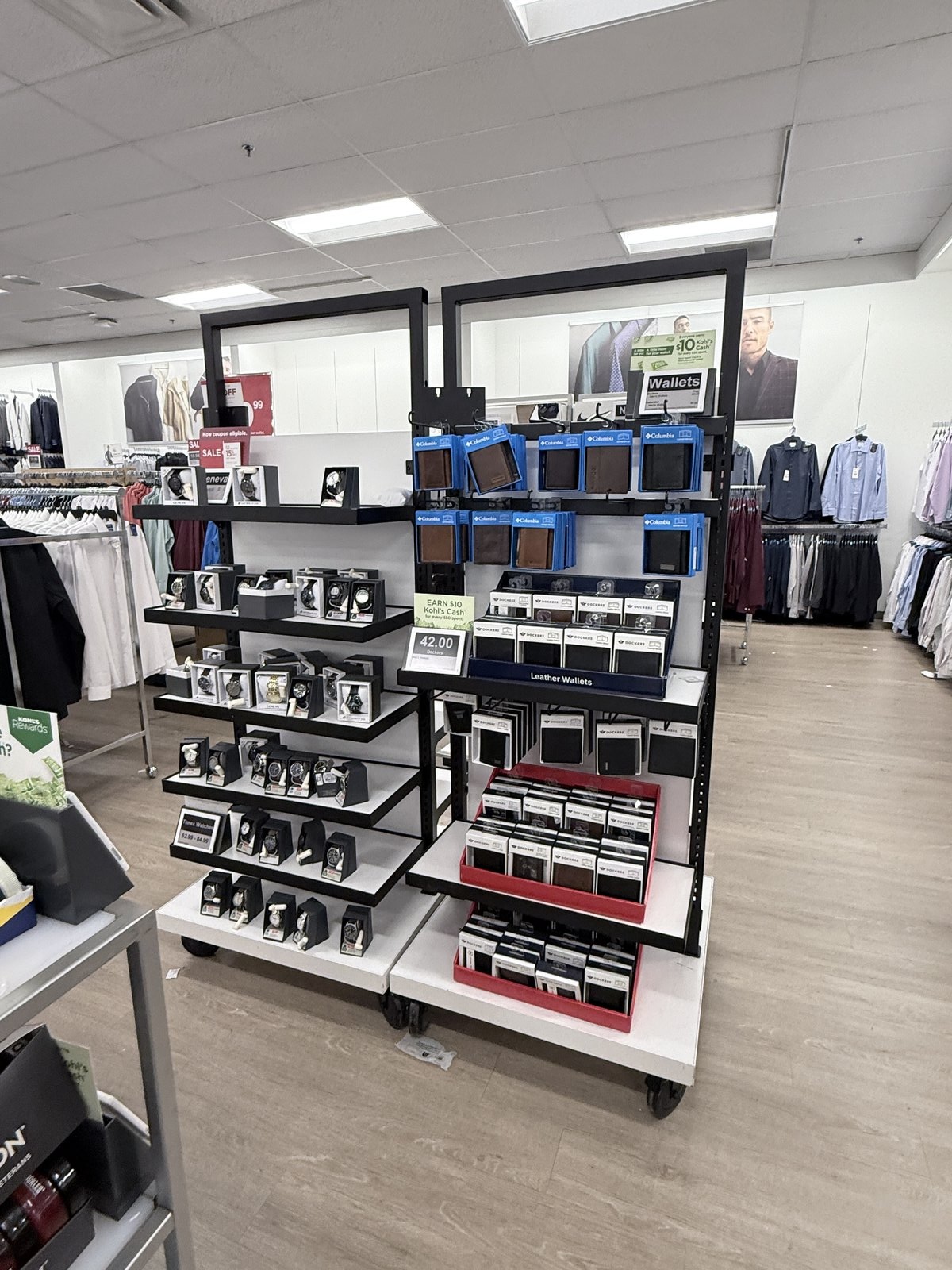
Plain box. No story. No features. No reason to buy over the one next to it.
- ✕All product in closed boxes — customer must open every item to evaluate it
- ✕No RFID callout, no capacity info, no slim profile claim, no material story
- ✕Products organized by brand — not by how the customer shops (by need)
- ✕No carry-type navigation — "Slim Carry", "Gift Ready", "Front Pocket" labels don't exist
- ✕Empty shelf space signals clearance, not a living category
- ✕Generic "Wallets" header — invisible next to other brands' destination displays three feet away
Where It Needs to Go — The Opportunity
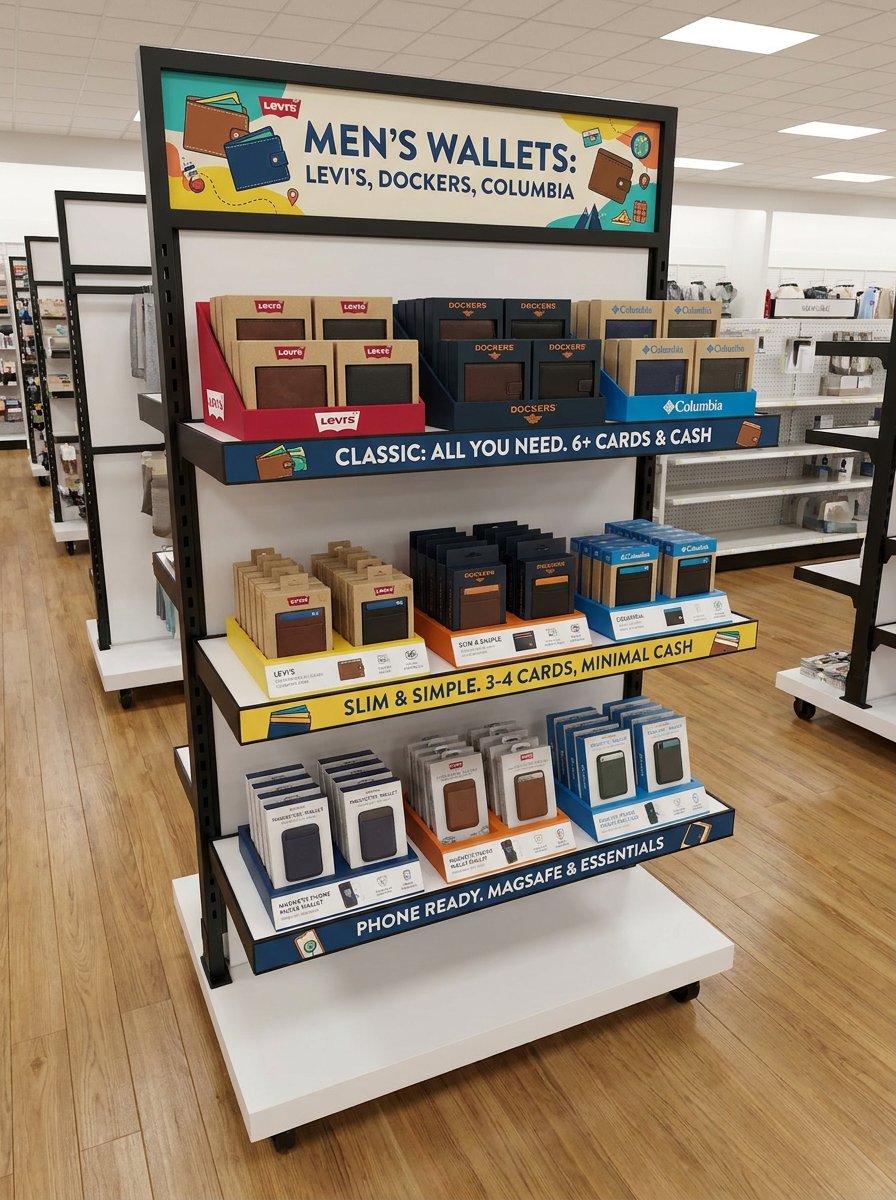
Packaging and display that sell before the wallet is touched — in-store and online.
- ✓Display organized by carry type: Classic · Slim · Front Pocket · Phone Companion · Gift
- ✓Category shelf rail labels and brand lifestyle header — a destination, not a shelf
- ✓One open wallet per tier — tactile, visible, feels like what it is
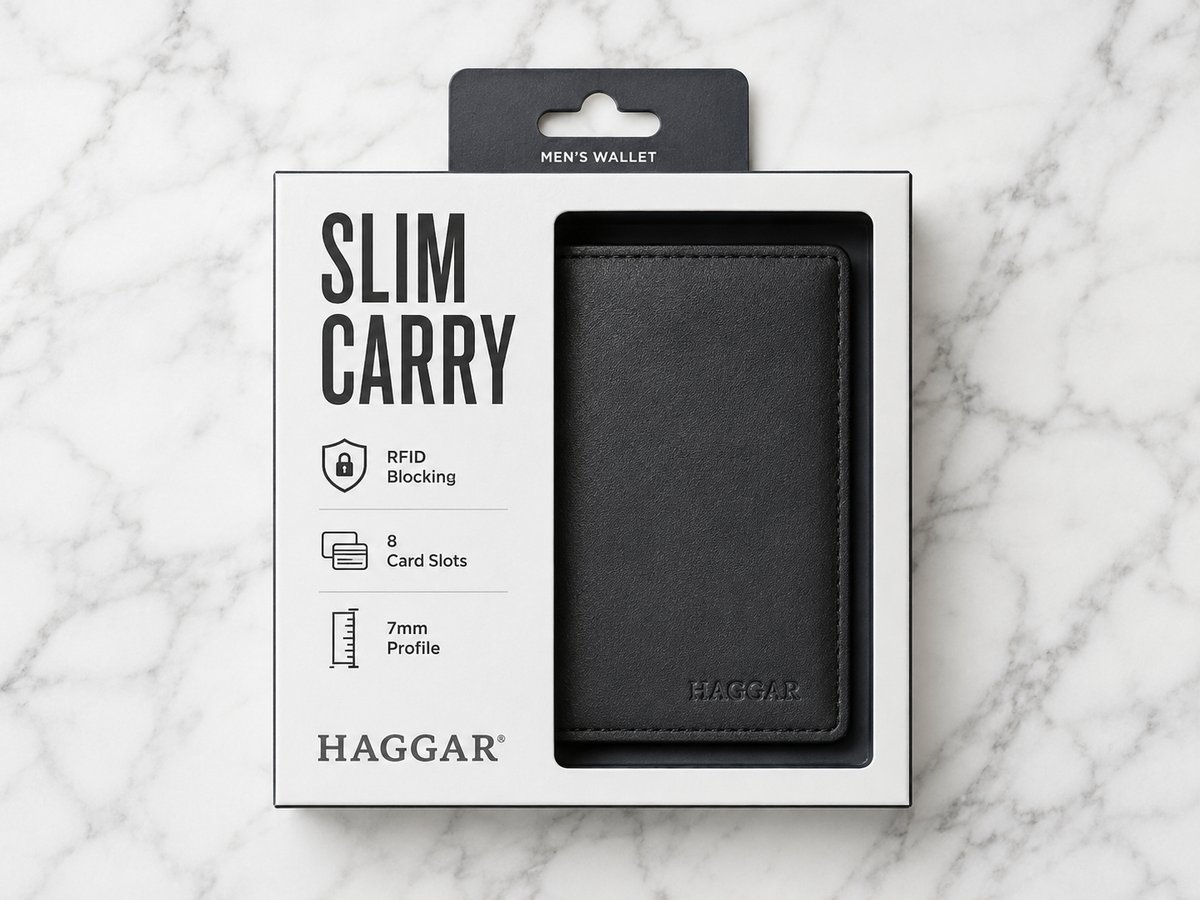
- ✓RFID badge + card capacity + profile dimension on front of every package
- ✓Gift section with premium packaging and gift sets for Q4
- ✓Online PDPs: lifestyle imagery, feature icons, same carry-type language as the fixture
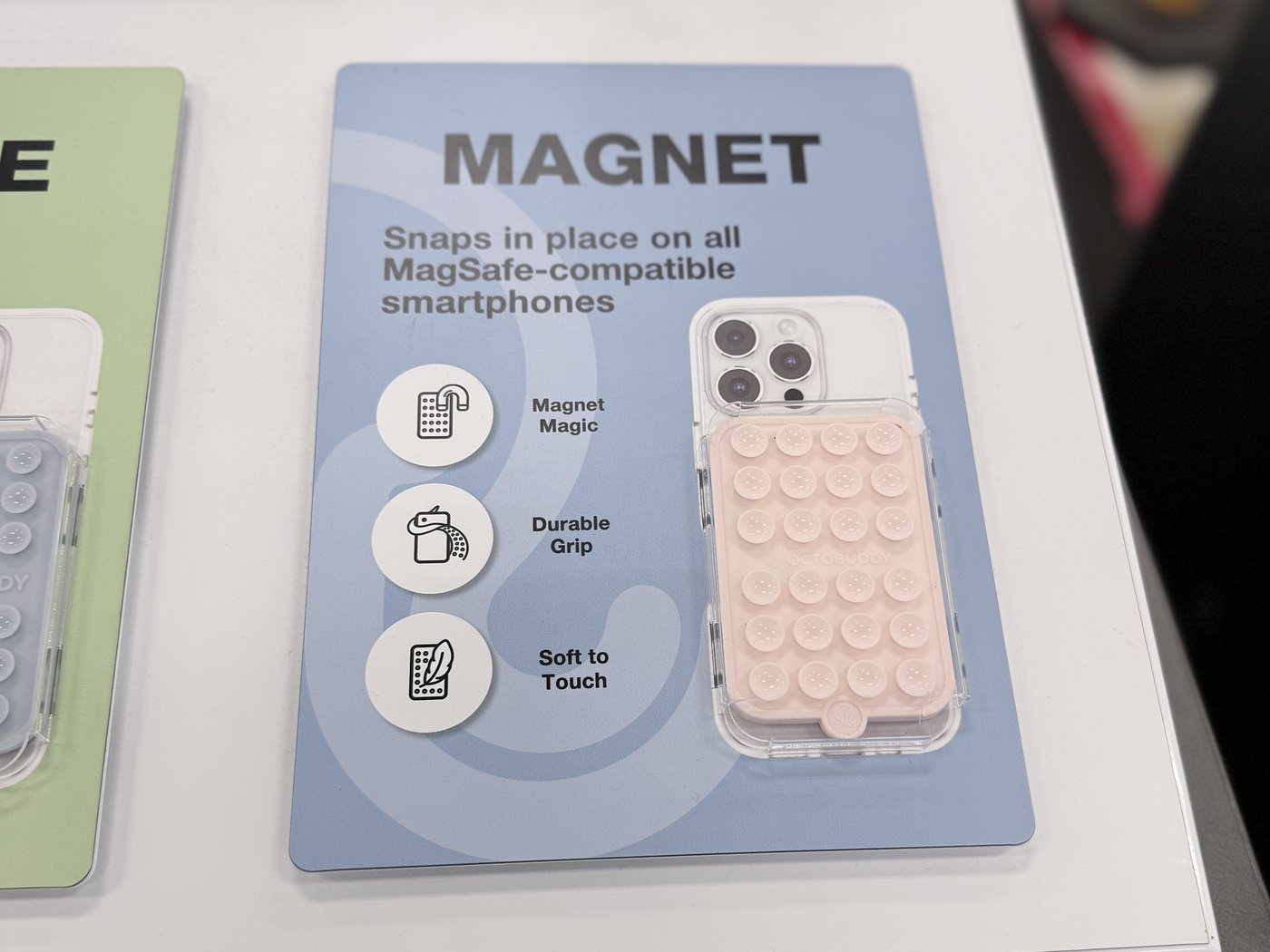
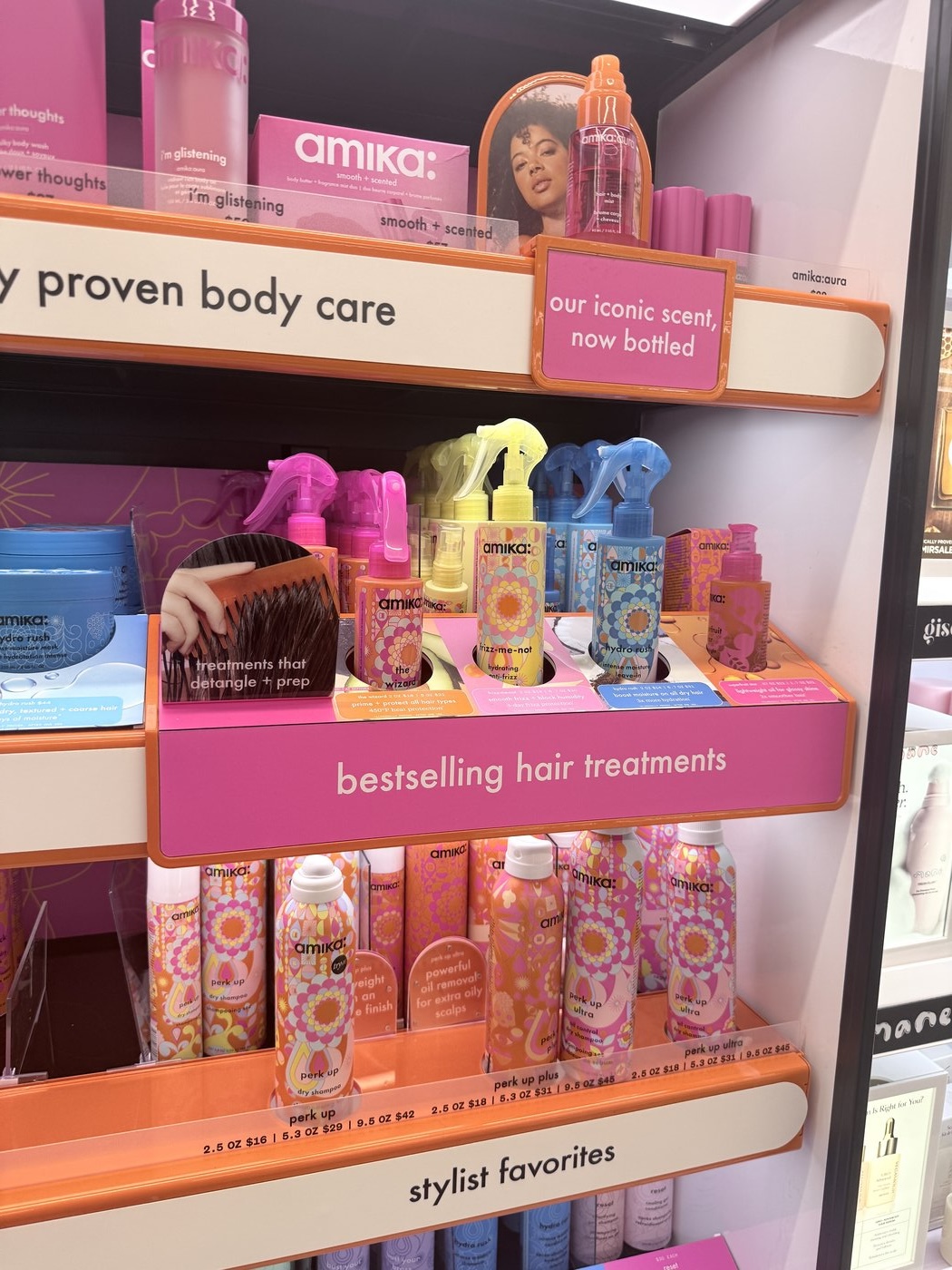
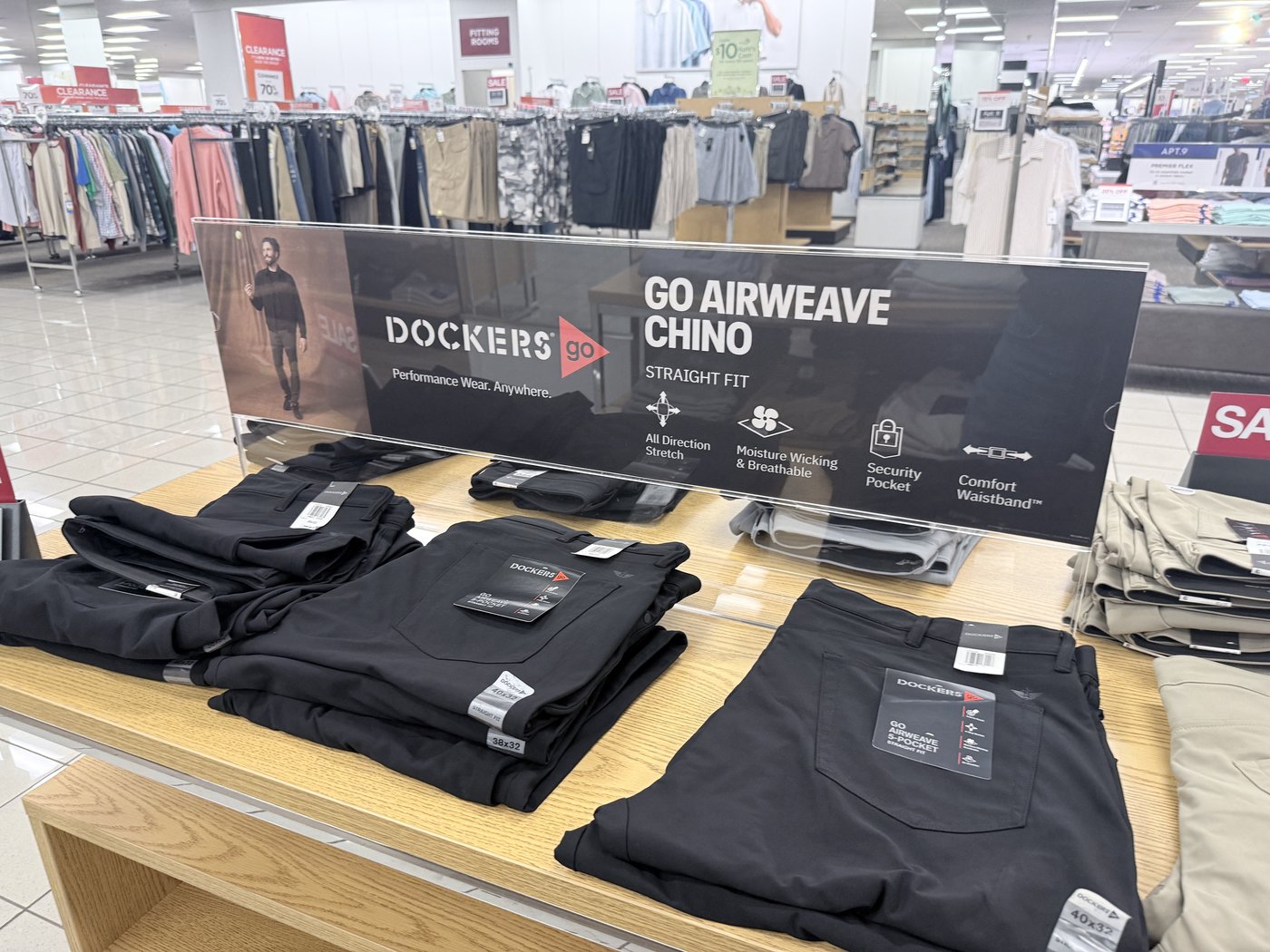
Learning from other categories Every image below was photographed in the same store as the wallets. None are premium DTC brands. This is not a budget problem — it is an intention problem.
The Research Case
The shelf is where this category is won or lost.
Every figure below is from a named study with disclosed methodology, and each is cited so it can be checked.
Packaging & Online
Good packaging communicates before the customer touches the product.
The goal isn't a beautiful box — it's a box that sells. That means three things on the front panel: what it holds (card capacity), what it does (RFID blocking), and what kind of carry it's built for. That same information should be consistent across every brand and every fixture, so the display and the package speak the same language.
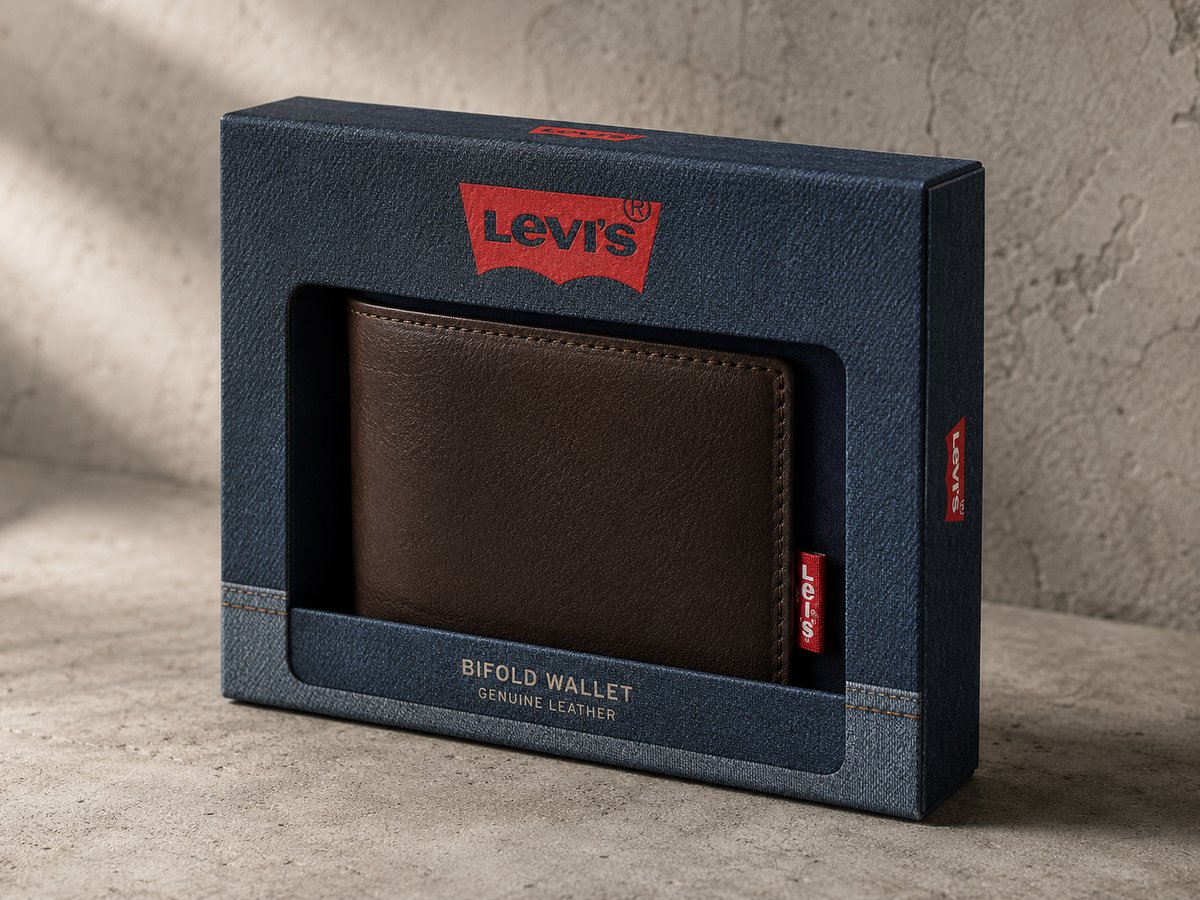
And the product page has to say the same thing.
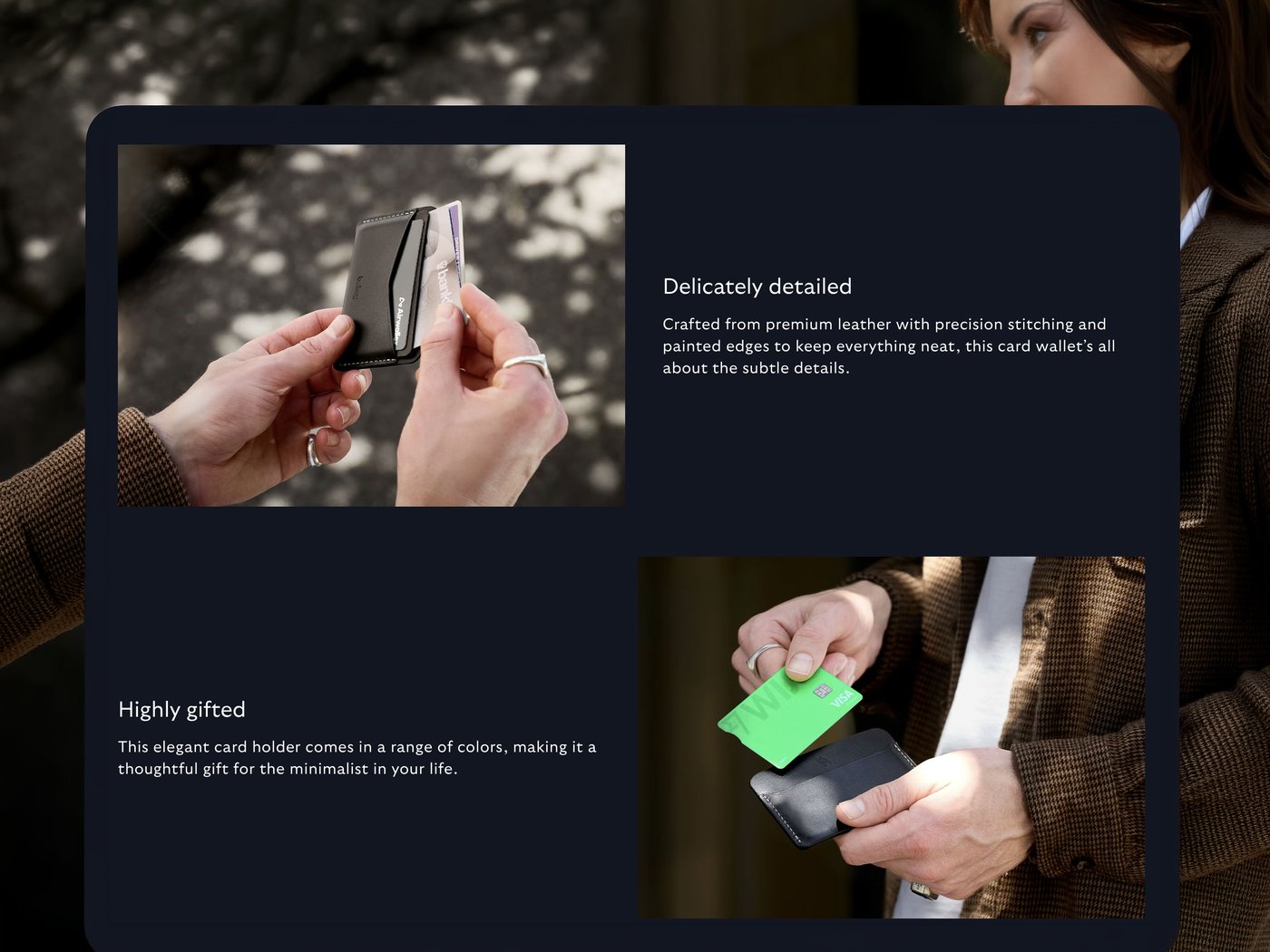
A shopper who sees the wallet on the fixture and then looks it up online should feel one brand speaking. Lead the product detail page — the PDP, the individual product page on a retailer’s site — with the product in hand rather than sitting in a box, then the same feature icons the package carries — RFID, card capacity, profile, material. The five carry-type names on the shelf rail should be the five filters in the online navigation.
The display teaches the customer the language. The PDP closes the sale. They have to use the same words.
The 2027 Plan
Four moves. Everything else is detail.
The evidence points in one direction: a smaller wallet, sold as a gift, decided at the shelf, with ID at the centre of the product story.
01
Build for five card slots, not twelve
Extra capacity keeps a real customer and stays in the line, but the growth is in Front Pocket and New Classic. Shift the SKU mix toward the thinner half of the carry ladder and stop treating slim as a niche.
02
Put ID at the centre of the product
The licence is the last thing the phone cannot take, and no state lets it go for at least this decade. Clear ID windows, quick-access ID slots and a real ID story on the package are the category’s most defensible feature.
03
Plan two peaks, and ship to the barbell
A dedicated Father’s Day programme — the fastest-growing occasion, and the one where department stores match online. Then a Q4 floor set in early October and a hard replenishment cut by 15 December.
04
Make the package do the selling
Card capacity, RFID and carry type on the front panel of every box. Carry-type rail labels on the fixture. One open wallet per tier. The same five words in the aisle and on the PDP.
What would change this plan: a state making a mobile ID legally sufficient without the plastic card, or biometric gates going mainstream at TSA. Both are worth a standing watch. Neither has happened.